
The “peace” “negotiations” between Iran and the U.S. seem to have gone nowhere. The tense ceasefire took hold on 8 April, which President Trump described as a window of opportunity to finalize a broader agreement, contingent on Iran fully reopening the Strait of Hormuz. Trump apparently accepted that Iran’s ten-point proposal was the “workable basis” for the agreement, but despite this positive development, disputes, mutual accusations and sabotage have continued apace. President Trump
On 12 April, direct talks between the American and Iranian delegations took place in Islamabad, Pakistan. After marathon 21 hours of talks, no breakthrough was announced. The main points of contention included Iran’s nuclear program, sanctions relief, regional de-escalation and free navigation through the Hormuz Strait. The Iranian side blamed the “maximalism” of the U.S. positions for the failure of the talks.
In the intervening days, both sides agreed to abide by the ceasefire to keep the window for diplomacy open and President Trump continued to maintain that the talks were going well and that a deal was “very close.” The next round of talks was supposed to take place during the weekend of 18-20 April in Islamabad again, but it seems that the window for diplomacy had shut.
This morning, the Iranian government made it official that there are no current plans to renew negotiations, again citing the maximalist U.S. demands as well as its violations of the spirit of the ceasefire. Given that the original ceasefire agreement expires in another two days (22 April), we could face a renewed escalation of the conflict. Trump is clearly trying to avoid this by proposing that the ceasefire be extended another week.
Overall, the diplomatic maneuvers we saw over the past week only highlighted the deep distrust between the U.S. and Iran. The ceasefire still appears to be holding, but without an extension or some form of a workable framework deal, the conflict could start again and escalate.
Earlier this month, President Trump has famously threatened to bomb Iran back into stone age where he thinks they belong, and a few days later stated that, “A whole civilization will die tonight, never to be brought back again.”
 12:47 AM · Apr 8, 2026 · 3.62K Views22 Replies · 15 Reposts · 90 Likes
Thankfully we got a ceasefire instead, but the threats and counter-threats continue. Over the weekend, Trump said that, “if we can’t reach a deal with Iran, we may have to bomb again.” Like nobody’s ever seen before, of course and true to previous threats, renewed U.S. bombing will likely target Iran’s energy infrastructure.
Iran has responded with their own threat: if the U.S. bombs Iran’s energy infrastructure, they will destroy the energy infrastructure of all the U.S.-allied nations in the region, including the Yanbu pipeline in Saudi Arabia, the Fujairah facility in the UAE, which is used to bypass the Strait of Hormuz, and a complete closure of the Bab el-Mandeb Strait.
JPMorgan Commodities Research provided this map illustrating exactly what this would entail:
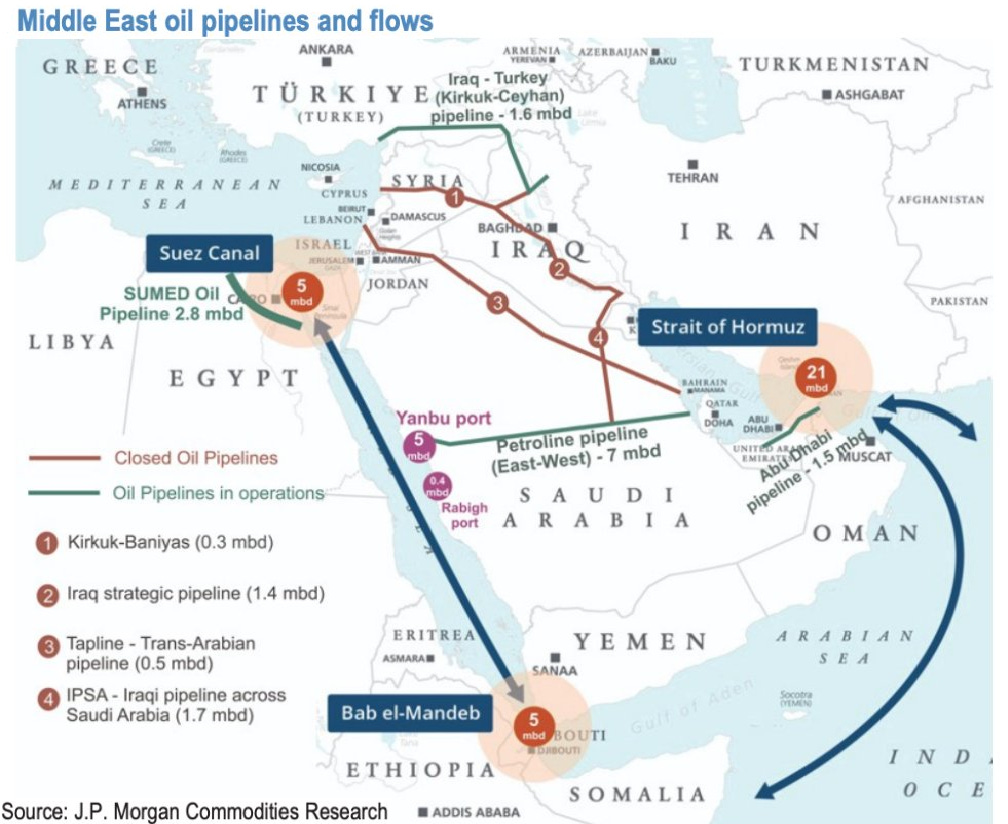
If fully realized this would create a massive disruption, taking a total of about 32% of global oil supply offline. About 20% of global crude oil supply passes through the Strait of Hormuz, but the real impact of its closure on global oil supply was “only” between 8-12% since some crude oil could be rerouted through alternative pipelines or other means. All the same, this has been the single greatest oil supply disruption in history of oil markets.
Renewed hostilities could worsen the situation dramatically, to the point that it could plunge the global economy into a crisis of unprecedented proportions that would be impossible to predict and its cascading long-term impacts difficult to mitigate. Hopefully, the danger of triggering these events will pull Iran and the U.S. from the edge of the abyss and pressure them to embrace real compromises and sustainable solutions to this conflict.
At the moment, we have little reason to feel optimistic. However, the worst case scenario in the Middle East could be so devastating, even to some of the most powerful players in global politics that risking it simply isn’t worth it. The price won’t only be paid in the energy markets but also in the financial markets. Many of the world’s largest banks are heavily invested in the Middle East economies and their collapse could trigger a severe financial crisis in the West.
For example, we learned yesterday that one of U.S. and Israel’s key allies in the region, the U.A.E. opened talks with the U.S. about obtaining a bailout if the war continues and further deteriorates the Emirates’ fiscal position. The UAE’s Central Bank Governor, Khaled Mohamed Balama asked U.S. Treasury Secretary Scott Bessent to help secure a US dollar swap-line from Federal Reserve.
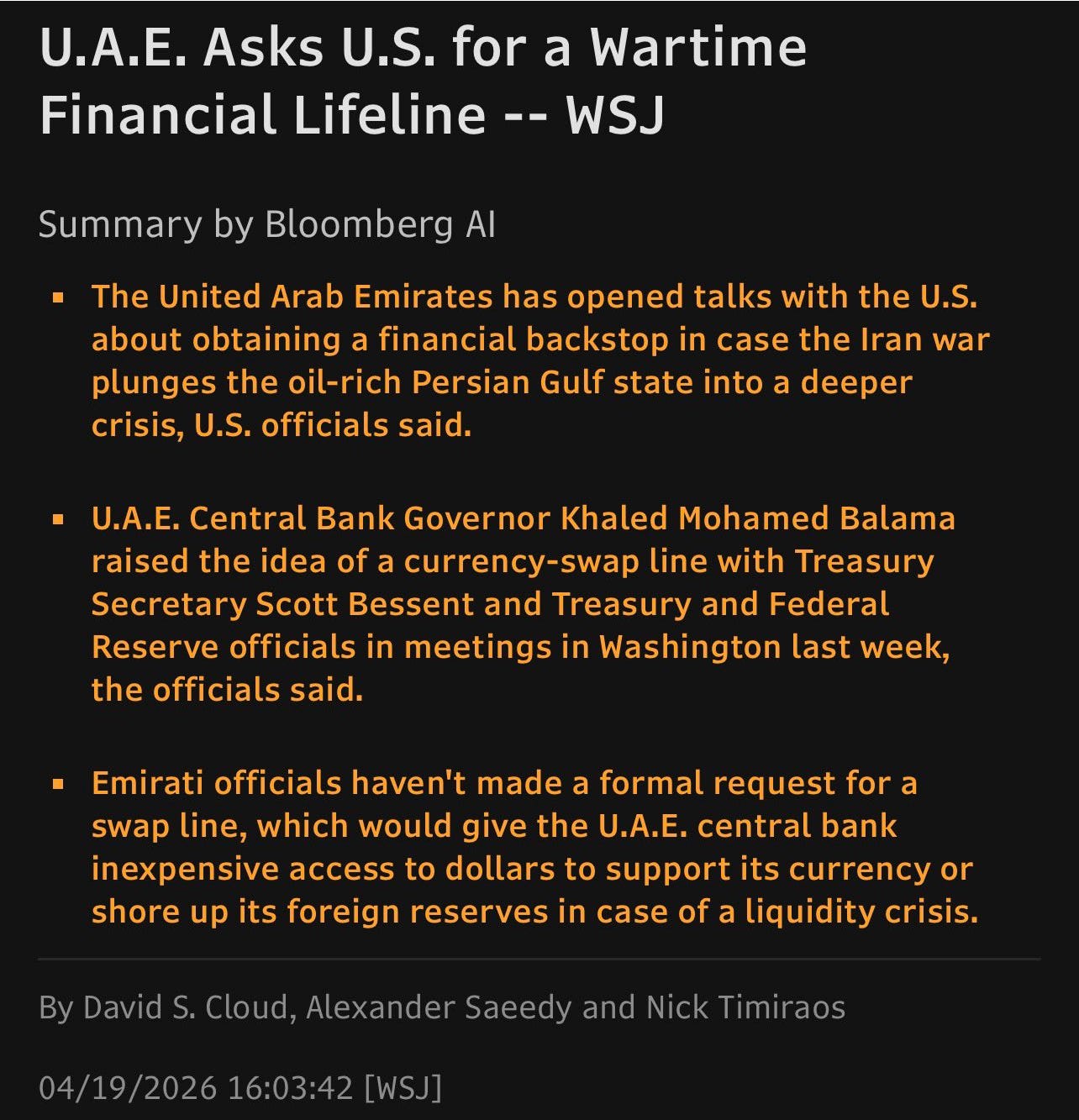
Presumably, the swap line should support the UAE’s peg to the dollar at about 3.6725 AED per 1 US dollar. However, if the UAE’s economy experiences sustained headwinds, this peg will be unsustainable and the U.S. will effectively be bailing out their ally. If hostilities between Iran and the U.S. continue to fester, similar requests for help could multiply from other allies, but also from banks and corporations with significant assets in the region.
This will put President Trump in a very tough situation to resolve the situation quickly. At the same time, Iran doesn’t have similar financial and time pressures. If anything, their position has significantly improved over the past 50 days. This week could prove critical in defining how the conflict might ultimately be resolved. At present, it seems that every alternative is possible.

.svg)


 By Independent News Roundup