
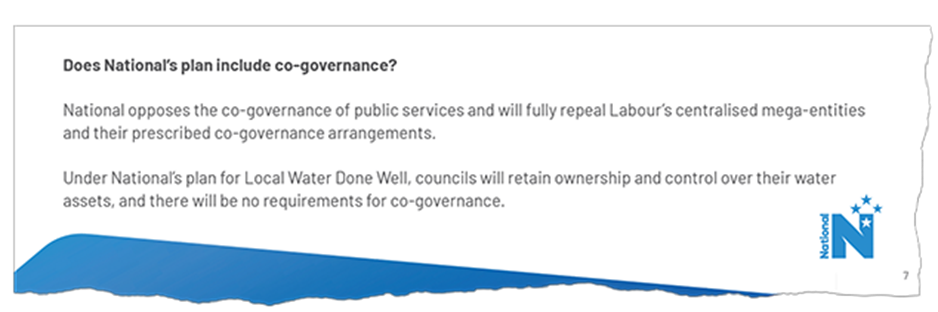
Co-governance is still alive and well under this coalition government contrary to what they promised prior to the 2023 election.
In my honest opinion after many years of watching politicians everywhere grab more power while dividing people with fear, race, and ideology; you can’t trust the political class or the media that protects them. They are often, deceitful (sometimes even corrupt) and thrive on control, division, and obedience, with results only being seen as important if they support the politicians stance on any particular issue.
This isn’t just happening somewhere else in the world, it’s happening here in NZ too. Our politicians are the same as others around the world and to a large degree I believe they are controlled by the same ruling class globalists and puppet masters who have their own hidden agendas.
Stopping the tribal takeover is what National, ACT and New Zealand First promised to do when they agreed to prioritise “Ending race-based policies” in their Coalition Agreement.
There can be no mature discussion about our future as a country until everybody accepts that the Treaty provided for the government to have final authority, with all citizens - no matter their ancestry - having equal rights.
When it comes to the pre-election promises to end race‑based laws and practices the Coalition has failed dismally.
Instead of being eliminated, Labour’s He Puapua programme to replace democracy with tribal rule remains embedded within the country’s legislative and regulatory framework.
Our Prime Minister is very quick to stand up and claim to have stopped the “Three Waters” program that was put in place under the previous Labour government; to try to claim the moral high ground, but in actual fact we now see that this claim is nothing more than a lie as the new version introduced by his coalition government (“Local Water Done Well”) contains the same models of undemocratic co-governance identical to the original Three Waters.
Water is a basic necessity for all life and as such it does not and cannot belong to any one group or race of people, it must be controlled by the government equally on behalf of all people of New Zealand.
I see in the latest communication from Peter Williams and the NZ Taxpayers Union that the government has just signed off on the local “Water Services Delivery Plans” that explicitly include co-governance as part of the new water entities.
The Taxpayers’ Union, Local Government Policy Analyst, has shared a memo which details the Delivery Plans of one of the new regional water entities.
The memo outlines the Metropolitan Wellington Water Services Delivery Plan: “developed jointly by the five Wellington councils working in partnership with mana whenua partners”.
The plan was approved by government officials just before Christmas but was only recently made public.
Minister Simon Watts is allowing councils to implement literally what he campaigned against just two and a half years ago.
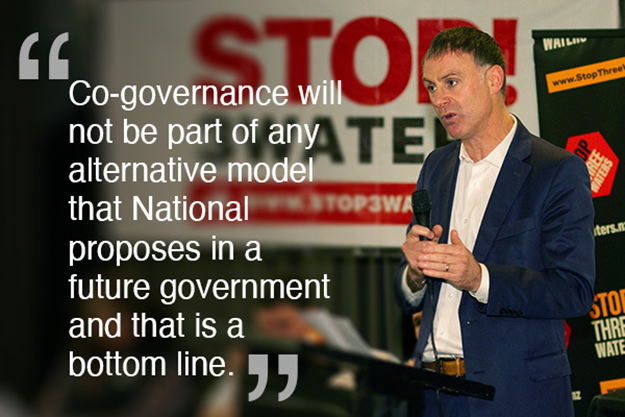
At the “Stop Three Waters” public meetings prior to the 2023 election the National Party spokesman for local government (now the Minister) Simon Watts repeated the assurance.
He said:
“National’s alternative to Three Waters will not have co-governance with ratepayer-owned assets remaining under ultimate democratic control.”
In Tauranga – in front of 500 supporters – Watts described it as a 'bottom line':
Behind closed doors, Government officials have approved a regional model where a co-governed “Partners’ Committee” sits above the water entity boards.
Rather than being appointed and accountable to democratically elected councillors, the regional water entity board members report to (and are appointed by) the co-governed Partners' Committee.
Worse still, in the case of the Wellington region, a secret Iwi ‘Partnership Agreement’ exists which, according to recently disclosed documents, strips away most of the rights of council “ownership”.
The publicly available “Service Delivery Plan” makes clear that the Iwi Partnership Agreement trumps the entity’s constitution and is binding on the water entity, its shareholder councils, and the Board.
That means, just like Labour tried with Three Waters, the concept of council or ratepayer “ownership” becomes a legal fiction.
Directors will be required to follow iwi advice on how to protect the "mana" and "spiritual health" of local water
The Delivery Plan locks-in “restoring Te Mana o te Wai” as “the vision” of the water entity. That is very significant. It effectively ties the hands of the directors to further that vision and adhere to requirements to promote the ‘spiritual health’ and mana of the water itself.
Under the environmental law passed by David Parker (which the new Government still hasn't repealed) the meaning of "Te Mana o Te Wai" must be determined by local mana whenua groups, as they are deemed the experts, and it can vary in different tribal areas.
What is being implemented is the same model as proposed originally by the previous labour government.
Having water entities operated by a board whose members are appointed by (and report to) a ‘co-governed’ committee, rather than democratically elected councillors, will mean higher water costs and less accountability.
Te Mana o Te Wai was introduced in 2020 under the previous Labour Government; the door was opened for regulatory intervention by Iwi authorities on spiritual grounds.
What are Te Mana o Te Wai Statements?
They are statements which may allow Iwi a role in formulating water management policy throughout New Zealand.
They are statements which the nation’s more than 1200 iwi and hapū can issue; in fact, anything an iwi or hapū decides is consistent with their view of matauranga Maori or tikanga (customs) concerning a freshwater body in their territory.
The reality is that water is of equal life-giving value to all, and any claims of ownership or management authority over water in the natural environment, will be highly detrimental to community relations and, potentially, the stability of New Zealand society.
Iwi through Te Ao Maori believe that water has a spirit; (“mauri” or “life force”) and the concept of Te Mana o Te Wai introduces vague, spiritual, and subjective frameworks.
The requirement of Te Mana o Te Wai to prioritise that spirit of water will lead to confusion, inconsistent interpretation, skyrocketing compliance costs, and an erosion of evidence-based decision-making.”
The management of our freshwater resources must be based on science and common sense. We cannot have a situation where Iwi authorities have a co-governance role based on their spiritual concepts, with the additional costs and cultural impositions this will involve.
This would only perpetuate and exacerbate the current situation where we have Iwi groups extorting money from resource consent applicants by the monetisation of their support for any such application.
Prime examples of such monetisation are seen in the recent huge payments made in relation the consent renewal applications for the Waitaki River Hydroelectricity dams and the payments made in relation to the water take from the Waikato River for the Auckland City water supply.
Public concern and anger over future water management in New Zealand becoming race based as a result of the adoption of the concept of Te Mana o Te Wai across the country.
Management of water in our natural environment should not be based on spiritual arguments from any single cultural authority. It must be science- and evidence-based, and this management must not incur costs that rest on cultural or spiritual beliefs. Such beliefs should be respected but not be embedded within our water management policies and processes.
It is a responsibility for everyone to ensure that water quality is preserved. We delegate this responsibility to government and local government, but Iwi do not have special knowledge that is otherwise unavailable through environmental science advisors to our elected officials.
Iwi authorities will be able to effectively hold the country to ransom if imposed costs from cultural or spiritual beliefs are part the management of the health and use of our water resources.
Monetisation of the control of water resources has already occurred. The ownership of the Lake Taupo lakebed passing to Tuwharetoa, the Waikato River Authority receiving $40m over the next 20 years from Auckland ratepayers and the Waitaki River payments, are examples of Iwi action on co-governance and its monetisation around the country.
New Zealand can’t afford for our economy and society to be stifled by this sort of arrangement. It is seen by the wider community as further examples of the use of cultural claims being used to justify payments to a small elite section of Iwi seeking to get their snouts in the public trough and make money from the water in our natural environment.
The coalition Government was elected with a mandate to restore the democratic processes in New Zealand and eliminate any type of race based regulation from our statutes and to achieve this in relation to our natural waterways would be to scrap any requirements relating to Te Mana o Te Wai.
The Government must also put in place rules to restrict Local Bodies who are currently enabling this gravy train culture to develop around the nation’s water resources. Water is a basic necessity of life and as such no single group in our society should be able to control it on cultural grounds, or derive income from it without adding value.
Water is a basic necessity for all life and as such it does not and cannot belong to any one group or race of people, it must be controlled by the government equally on behalf of all people of New Zealand.
Iwi claim to have a special cultural relationship with water and that may be so, but water must be seen as a public good which belongs equally to all citizens of New Zealand.
The Six Principles of Te Mana o te Wai mean that, through their statements, iwi representatives will have wide-ranging powers that lack strict definitions and limits — or democratic protections. They include:
• Mana whakahaere, which gives tangata whenua “the power, authority and obligation to make decisions that maintain, protect, and sustain the health and well-being of, and their relationship with, freshwater”.
• Kaitiakitanga describes the obligation of tangata whenua “to preserve, restore, enhance, and sustainably use freshwater for the benefit of present and future generations”.
• Manaakitanga is the process by which tangata whenua “show respect, generosity, and care for freshwater and for others”.
These three principles alone offer a very expansive brief and iwi will have wide latitude in formulating their monitoring policies and consequently, they will be able to wield immense power over control of the waters.
The Maori view of water has an indivisible interlocking of the practical and spiritual, the Maori King, Kiingi Tuheitia, in his speech at the 16th anniversary celebrations of his coronation in Ngaruawahia made it clear how important spiritual considerations are for Te Mana o Te Wai, saying:
“Te Mana o Te Wai belongs to us, to our iwi. It is about our relationship to our taonga [treasures] and about the wairua [spirit] of our water.”
This means that we could well see spiritual values such as the home of Taniwha influencing water policy under Iwi issued Te Mana o Te Wai statements.
Non-Maori, who make up approximately 83 per cent of the nation’s population, are denied the right to issue Te Mana o Te Wai statements no matter what their own views may be on water management, or indeed the spiritual beliefs they may hold about it.
It is now widely understood that “co-governance” means equal numbers of representatives from mana whenua and councils forming the groups which will oversee the regions water assets.
But, in fact, co-governance at the Local Body level is just one element of the comprehensive control of water being granted to iwi alongside others including requirements in relation to; the principles of te Tiriti o Waitangi/the Treaty of Waitangi; and perspectives of mana whenua, matauranga, tikanga, and te ao Maori”.
Those requirements will in fact mean that iwi have the final say on running the nation’s water infrastructure and in fact given these requirements, it is not co-governance at all; it is direct iwi governance — and Te Mana o Te Wai statements are the primary mechanism for enabling that.
There are no defined criteria as to what the statements may contain and as such they give the Iwi total power over and control of water throughout New Zealand.
What will be the outcome from these Statements?
Given that the water infrastructure which has been built up and paid for over many generations by ratepayers and taxpayers, both Maori and non-Maori alike, the fact that 17 per cent of the population will get to decide exclusively what is best for the remaining 83 per cent in the management of water and the infrastructure is outrageously divisive and entirely undemocratic.
The proposed transfer of control of the water infrastructure and management of the water to Iwi, through these proposals is no more than theft of our assets and implementation of “Apartheid” into the management of water in New Zealand.
The coalition government made many promises from the constituent parties, (both before and after the election) that they would make every effort to eliminate racial preferences from government decision making, in a commitment to equal citizenship under New Zealand’s democratic system of government.
Yet we still see them showing support for the handing over of control of our water resources to tribal interests under these Te Mana o Te Wai statements.
In light of National’s claims around building a society based on following our democratic principles, equal citizenship, equal opportunity and despite the clear mandate against racial division and co‑governance that was delivered to the Coalition at the election, not only are activist Treaty principle clauses continuing to shape policy advice and decision‑making, but official references to the original Treaty of Waitangi are being replaced with “Te Tiriti” – a radicalised version that embodies He Puapua through Treaty partnerships and co-governance.
Prior to the 2023 election the current Coalition Government parties promised to reverse race-based laws and practices.
Much of the government bureaucracy (both central and local) has demonstrated support for co-governance and outright resistance to any change, that without decisive action to remove divisive race‑based provisions from law and practice - and to reassert the primacy of Parliament - the drift towards tribal governance will continue. This represents an enormous threat to New Zealand democracy.
The electorate voted for change and currently they are not getting that change. In fact if we look at the current government’s actions we can see that instead of change we are actually getting more of the same race based legislation that the electorate voted against in 2023.
We see in the Fast Track Bill that this government is in fact including more requirements based on ethnicity rather than less (as evidenced by the guaranteed appointments on the evaluation panels solely based on ethnicity).
“Iwi” are mentioned many times in the Bill and the proposed four-person evaluation panels are designed to include one person nominated by the relevant local authority and one person nominated by the relevant iwi.
This design for the evaluation panels will result in giving Maori an equivalent voice to the local authorities. Given that Maori make up only approximately 13% of the voting population of New Zealand (according to the latest NZ census) this gives them a much greater influence over the outcomes from any fast track applications above other ethnicities in New Zealand.
The proposal to have a mandatory position on the evaluation panels, solely based on ethnicity is nothing more than apartheid dressed up in a different disguise.
Their justification for introducing this into the Bill is that there is some type of partnership requirement under the Treaty of Waitangi that requires a system of co-governance to be implemented.
Their latest replacement legislation for the Resource Management Act, the National Environment Bill and the Planning Bill also still provide for co-governance and also contain provisions to allow for setting of taxes relating to fresh water.
Federated Farmers says a water tax by stealth is buried in the Government’s proposed RMA replacement legislation, warning the bills create an enabling framework for pricing-based allocation of scarce natural resources that could, in practice, land as a levy on water users.
Federated Farmers argued that even if the Government had no present intention to tax water, the legislation would give ministers “sweeping powers to tax water as a tool for managing demand”.
It said the bills allowed ministers to “auction, tender, and manage demand for natural resources like freshwater through a competitive pricing process”, and to introduce “natural resource levies” to fund purposes including restoration and managing demand.
At the centre of that claim is the Natural Environment Bill’s market-based allocation (MBA) framework, which would allocate natural resources where demand exceeds supply using a competitive pricing process, rather than relying on first-come, first-served permitting.
But charging for access challenges longstanding expectations among existing users about how freshwater is allocated.
While the framework is presented in terms of “natural resources” rather than water specifically, freshwater allocation is the most likely flashpoint because scarcity is most visible in fully or over-allocated catchments.
The problem with the acceptance of a partnership requirement under the Treaty of Waitangi is simply that there is no mention anywhere in the Treaty documents of a partnership or of any co-governance requirements.
Given the level of opposition to the previous Labour governments race based policies and legislative changes it is obvious that the current coalition government has no mandate for inclusion in these Bills of mandatory appointments based on ethnicity.
We are constantly being told that the Treaty of Waitangi created a partnership between the Crown and Maori and to fulfil this we need to adopt a system of Co-Governance with Maori.
The idea being that Maori will have fifty percent of control and all other races will have the other fifty percent.
This whole idea of Co-Governance is nothing more than a racist attempt to gain control based on an erroneous interpretation of the Treaty.
Apartheid by another name!
Co-governance is not about the Treaty it is solely about control and getting the monetary benefits that go with having control. It’s about a small percentage of the population (approximately 17%) getting fifty percent of control based on their ethnicity and the others (approximately 83%) getting the rest.
This push for Co-Governance has got nothing to do with honouring the Treaty; it is all about gaining control and getting snouts in the trough of public funding.
We also have many local bodies signing off on co-governance agreements as if they are making some magical step towards implementing Treaty requirements when in actual fact all they are really achieving is to introduce a race based bureaucracy which is nothing more than turning democracy into Apartheid under the name of Co-Governance.
If like me you wish to argue against this happening the first thing that happens is that you are immediately labelled as a racist supporter of colonization which has been the cause of all things bad for Maori in New Zealand since the inception of the Treaty.
We have operated under a system of democracy which has been based on the principle that all persons are equal in the eyes of the law and entitled to equality in the political and governmental processes but now we have this section of the population which wants to divide the country based on ethnicity.
If we are to have unity/equality it won’t be through Co-Governance. Co-governance doesn’t unite us—it divides, inflames, and festers. We don’t need more committees and cultural vetoes; all we need is one law for all.
We have allowed a relatively small group of people to continually make ill-considered and incendiary comments, around the issue of Co-Governance with many of them receiving public funding, and support?
We have allowed a climate to develop where these extreme views have almost become accepted by sheer repetition and the absence of counter-arguments.
It has become almost impossible to challenge those views as you are immediately branded as a racist and the mainstream media will not print any opposing views.
In allowing these extreme views to become accepted through our failure to strongly oppose them, we have failed to defend our hard-earned freedoms and our democratic values; allowed dangerous ideas to permeate our cultural and educational institutions; and enshrined lies where there was once truth.
It is time we stopped accepting that there is any basis that political power should be based on ethnicity or that ethnicity is any type of qualification for Leadership of our country. The future of New Zealand doesn’t belong to tribes—it belongs to all of us, equally; we all matter the same.
New Zealand has had a democratic system of government that is the oldest in the world, going back to the emancipation of women under the suffragette movement when they were granted the inalienable right to vote regardless of colour or gender in 1893.
On 19 September 1893, Governor Lord Glasgow signed a new Electoral Act into law, and New Zealand became the first self-governing country in the world to enshrine in law the right for women to vote in parliamentary elections.
Yet here we are currently, with the self-appointed so-called tribal elite of Iwi trying to go back and reinstate a system of race based governance.
Race based governance has never succeeded anywhere and it would not be any different here in New Zealand if it was implemented.
We have been lied to!

.svg)


 By Andy Loader, Poke the Bear