
In yesterday’s report we discussed the way another escalation of war in the Middle East might impact global oil markets. In the worst case scenario, the entire region’s energy infrastructure could be impaired, reducing global oil supply by as much as 32%. Unfortunately, the standoff between the U.S. and Iran is not the only factor that is now causing large scale disruption to the world energy production.
Over the recent months we’ve witnessed a series of targeted attacks on energy infrastructure in other parts of the world, coupled with multiple industrial accidents that have become so frequent, it’s become difficult to keep track of them. In just the last five days, there have been six unrelated incidents:
This morning we also learned about a “massive” explosion of an oil rig registered near Etoile, Texas (U.S. Department of Homeland Security already attributed the attack to Iranian sleeper cells). Of course, most of these incidents could be coincidences, but they’re only a small set of what’s been happening for months now. The following list will prove a greater challenge for coincidence theorists:
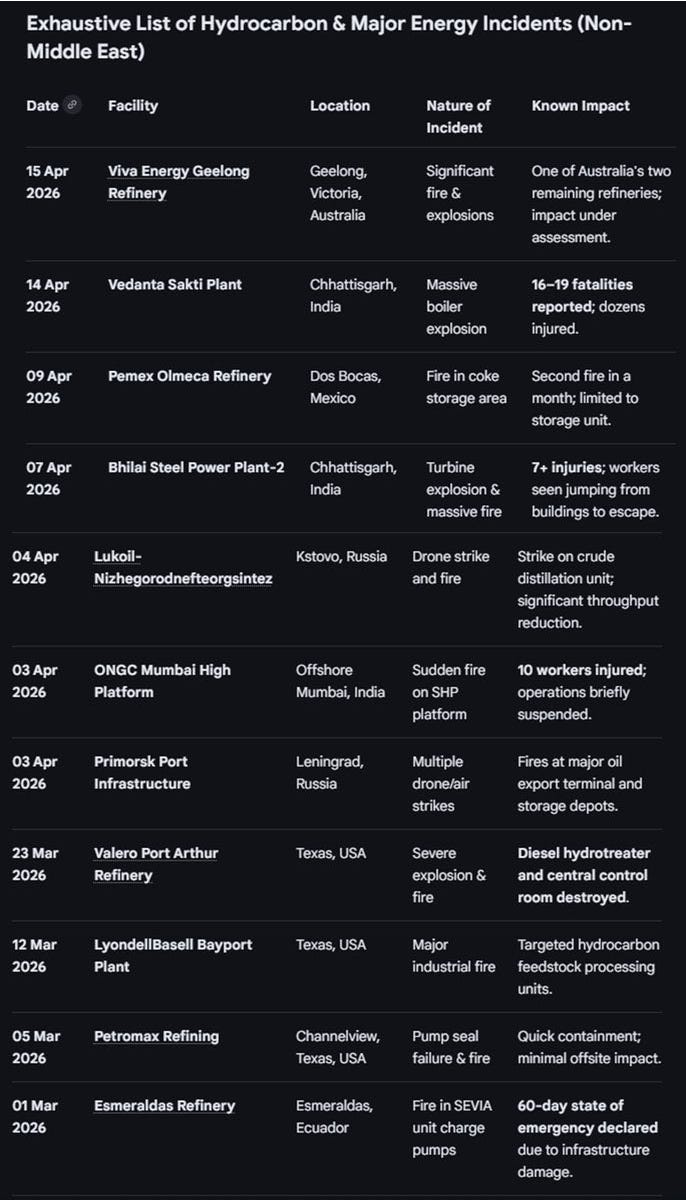
In addition, we have seen multiple attacks on the Russian tanker “shadow fleet,” and pipelines, including the destruction of the Nord Stream pipelines in 2022.
In view of all this, the price of crude oil - at least so far as the Brent and WTI benchmarks are concerned - may still be too low to reflect these realities. Brent crude has peaked at $120/barrel in March, but over the ensuing weeks it dropped back below $100/bbl (it is currently trading near $96/bbl). At the same time, WTI, which also soared to $120 now dropped below $90/bbl. There has been a lot of speculation that this is principally due to market manipulation, which is certainly plausible, but part of the explanation is also in the very nature of markets and the process of price discovery.
As I pointed out in the past, large-scale price events (LSPEs) almost invariably unfold as trends, spanning months or years. In the recent past, we saw the price of gold languishing for nearly three years in a horizontal range between $1,800 and $2,000 per troy ounce. Then, at the beginning of 2024 the price broke higher and continued to rise over the following two years towards its new all-time high at over $5,500/tr.oz.
That LSPE involved a price discovery process that spanned nearly two years, and I expect that we might see a similar process unfold in energy markets over the coming months. Market analyst Lukas Ekwueme (@ekwufinance) summed up the market reaction to the 1973 OPEC embargo, which also manifested a certain inertia and a LSPE that spanned six years:
“… oil moved first: from ~$4 to ~$10 during the 5-month embargo. But the real move came after. Over the next 6 years, oil kept rising, eventually peaking at ~$40, another ~4x higher even after the embargo had ended. The embargo didn’t just cause a temporary spike.... it reset the entire pricing regime. The pre-embargo price never came back… oil entered a new reality.”
Equity prices also readjusted over a longer time interval: two weeks after the embargo was declared in October 1973, the S&P dropped about 24%. Then came a period of consolidation lasting some5 months before staging another another leg down of about 33%.
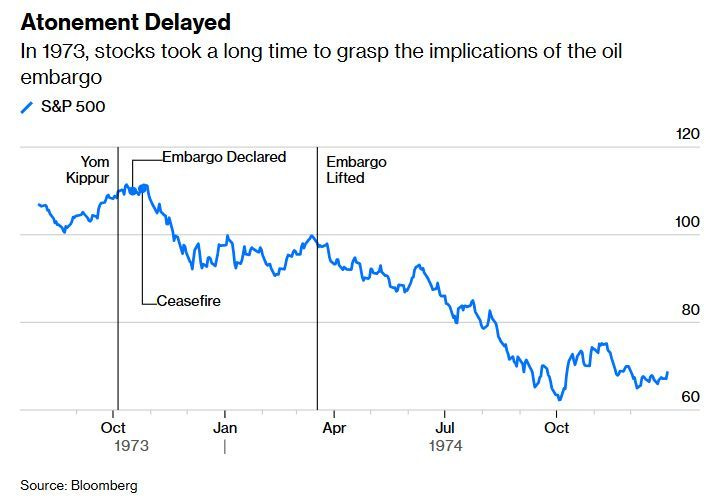
The episode is yet another corroboration of our core thesis that markets move in trends. We may not be able to predict their trajectory with any degree of accuracy, but by adhering to a set of systematic trend-following strategies with discipline and patience, we should always be able to generate substantial windfalls from such LSPEs in almost any market, regardless of whether the prices are rising or falling. The rewards never come overnight but accrue over long stretches of time, which is why discipline and patience are as important as having an effective strategy.

.svg)


 By Independent News Roundup