
The power of the people is their voice.
It’s our quantity that gives our voice power.
It’s this power, ‘they’ fear the most…
When the elite who run the world, know that the masses are not supporting them anymore, their tool to remain in power is to silence their opponents. You can see this happening throughout the entire history.
Whenever a dictatorship arose, the first thing that new dictatorship did, was silencing its opponents. These opponents were mostly highly educated and respected people, who understood what was going on. They tried to warn their fellow-citizens by writing books, articles and pamphlets. The way to silence them was to ban these writings, to make them illegal and burn them.
This is how ‘history has been changed’ so many times. The conqueror decided what narrative would survive. The critical voices were hunted down and silenced.
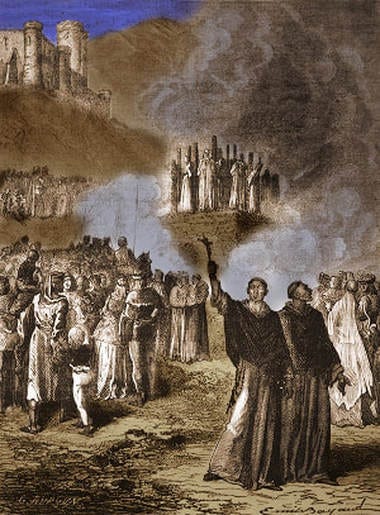
Did this practice change in time?
Has our civilization reached that level in which democracy decides its fate?
Unfortunately not.
People are still hunted down and silenced, book are still being burned.
Just think about Reiner Fuellmich and Arno van Kessel. Two lawyers who are imprisoned for exposing the covid hoax via the legal route. I’ll tell you Reiner Fuelmich’s story soon, I promise.
And the book burning?
That still happens ‘big time’, being intensified during and after the covid era. It’s happening mainly online and is called censorship.
In order to make their censorship actions legal, most countries have adopted new laws by now. Legal and righteous is something completely different, as we shall see.
The European Union has created the Online Safety Act to legalize censorship: it’s also known as the Digital Services Act (DSA). ‘It aim is to create a safer digital environment by regulating online platforms and services to protect users from illegal content and harmful activities.’
Let me show you how this law, that aims to protect the ordinary people like you and me, works out in reality.
Since the UK is no longer part of the EU, it acts like its ‘fore-runner’ in rolling out Agenda 21 and Agenda 2030. The development of 15-minute cities and enforcement by digital control, shows us how our future is supposed to become. The UK has adopted its own law for censorship, the Online Safety Act 2023.
While the government presents this ‘new set of laws to protect children and adults online. It puts a range of new duties on social media companies and search services, making them more responsible for their users’ safety on their platforms.’
‘The Act will also protect adult users, ensuring that major platforms will need to be more transparent about which kinds of potentially harmful content they allow, and give people more control over the types of content they want to see.’
The term ‘potentially harmful content’, is up to a variety of interpretations. The most important fact for me, is the word ‘potentially’. When ‘in the old days’ people could only be imprisoned for actually perpetrating a crime, these days it’s enough to become arrested for the ‘potential harm your content can cause’.
Let’s see what that looks like in reality:
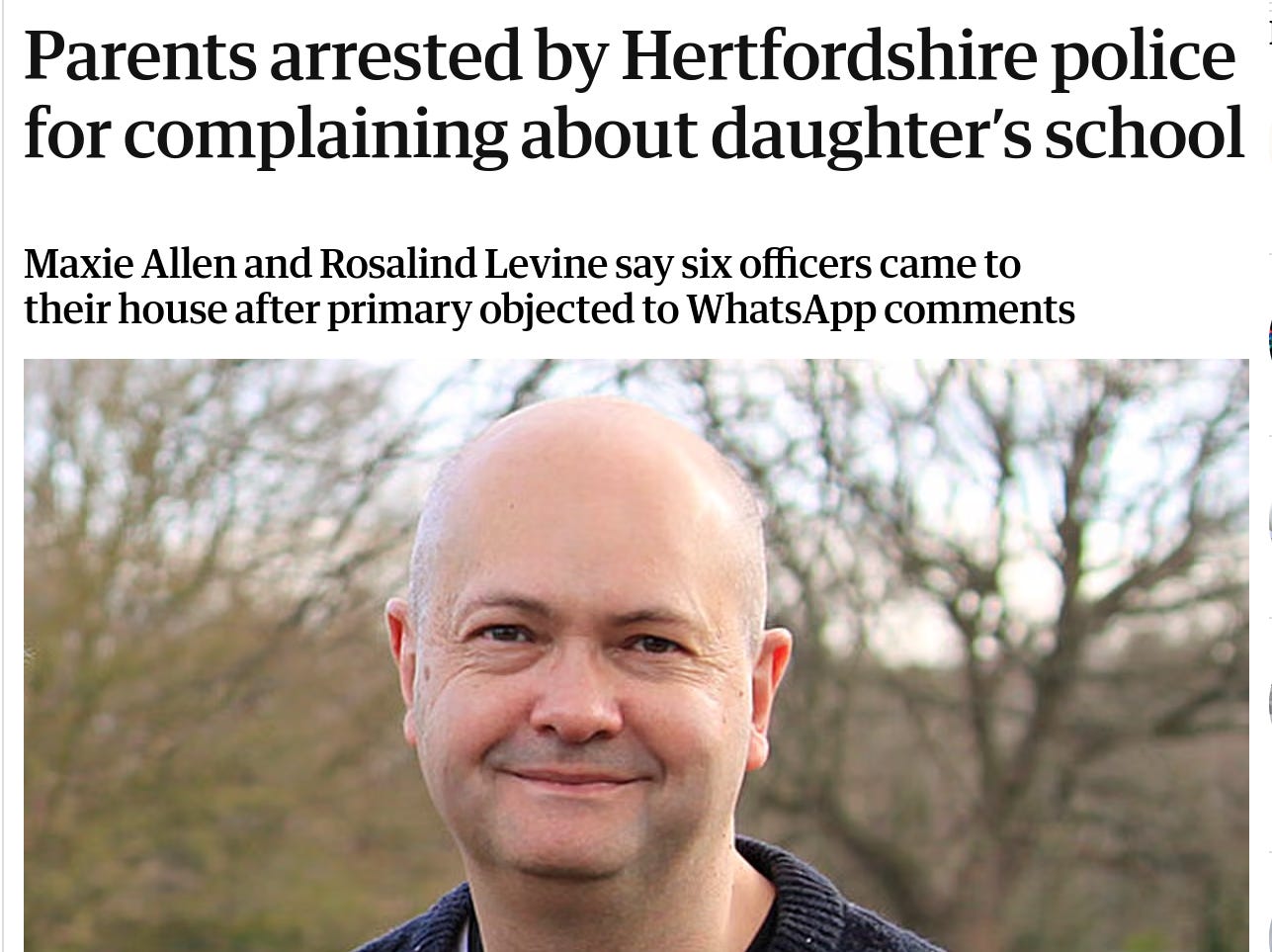
Last year, Maxie Allen and Rosalind Levine — the parents of a 9-year-old girl in Hertfordshire — were arrested in front of their daughter after exchanging messages critical of her school’s new headteacher in a WhatsApp group. Six officers arrived at their home, seized their devices, and the couple was interrogated for hours over allegations of malicious communications.
“We’ve gone from being concerned parents to criminal suspects — over a private conversation”, said Allen.
The school said it had “sought advice from police” after a “high volume of direct correspondence and public social media posts” that they claimed had become upsetting for staff, parents and governors.
Hertfordshire police said the arrests “were necessary to fully investigate the allegations as is routine in these types of matters”.
“In relation to the police visit on 20 December, a complaint was submitted which was reviewed by our Professional Standards Department. It was deemed that the service provided by officers was appropriate.”
Yes, appropriate ‘service’, due to the new laws…
The UK Online Safety Act aka Censorship Act is being applied for “hate-speech” as well. Hate crimes legislation can be applied with disturbing vagueness, having led to the police investigating more than 120,000 so-called “non-crime hate incidents” in 2020 alone.
To make things even worse: British officers make around 12,000 arrests annually under Section 127 of the Communications Act 2003 and Section 1 of the Malicious Communications Act 1988.
An example:
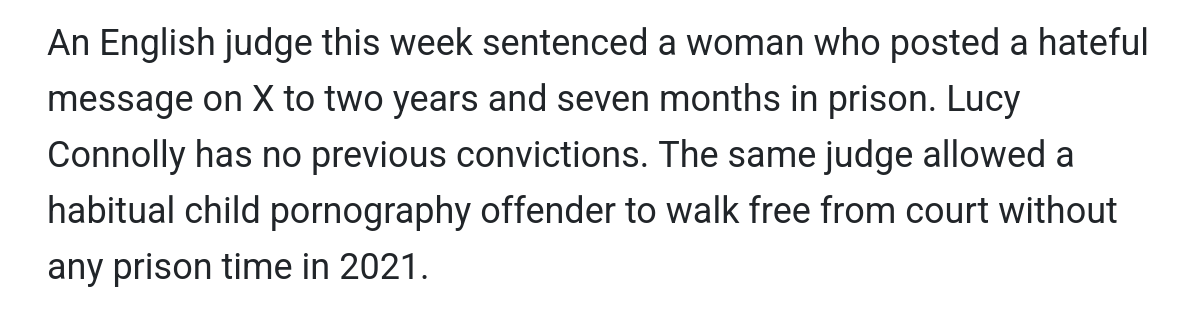
Numerous arrests have been made of people who did nothing but post their feelings or opinions on social media.
For example, a 55-year-old woman was arrested for a social media post she shared that claimed a suspect of a violent crime “was an asylum seeker…”
“If this is true,” she stated, “then all hell is about to break loose.”
Dimitrie Stoica was arrested for making a TikTok video in which he pretended that rioters were chasing him.
“As has been made clear… any criminal actions… whether in person or online, will be dealt with quickly and robustly.”
Prime Minister Keir Starmer said:
“This is not a law free zone… whether you’re directly involved or remotely involved you’re culpable…”
And then there’s even more legislation, making public expression punishable:
In 2022, the government passed the Police, Crime, Sentencing and Courts Act, giving law enforcement expanded powers to shut down protests deemed “noisy” or “disruptive”.
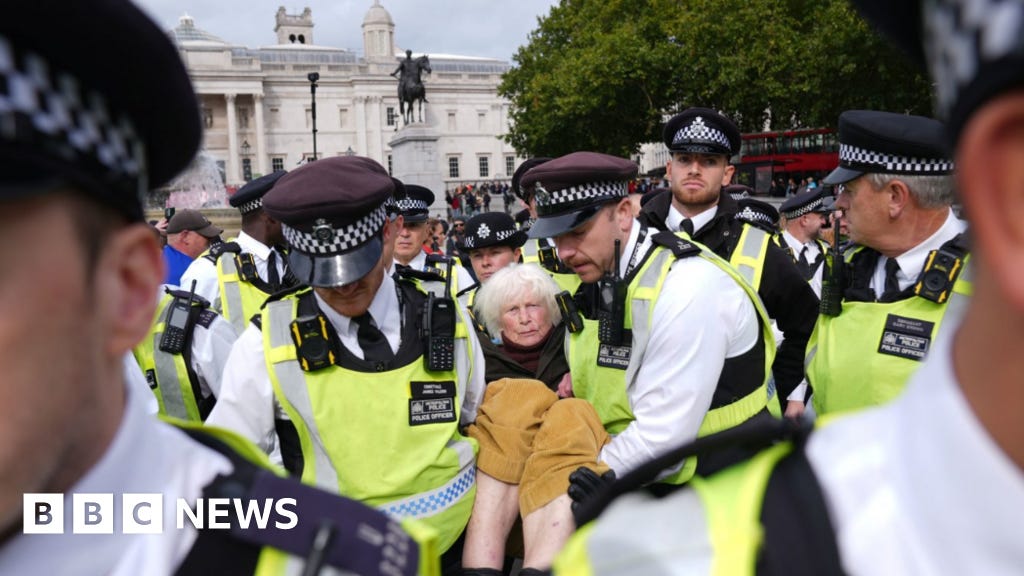
Defining its own citizens as ‘potential terrorists’ in order to protect ‘vulnerable groups’ is showing us where this society is heading to.
The UK Terrorism Act 2000 defines terrorism broadly — yet its application continues to evolve in controversial ways.

.svg)


 By Independent News Roundup