
Smart Dust originated as a military-funded research program, primarily supported by DARPA, with the aim of developing rapidly deployable sensor networks for battlefield environments.
The core function of such systems is detection. Specifically, detecting individuals without their awareness. As a result, invisibility and undetectability are not secondary features. They are fundamental design priorities.
The concept entered broader public awareness through US Patent 11,354,666 B1, titled “Smart Dust Usage,” filed in May 2016 and granted in June 2022. The patent, assigned to Wells Fargo Bank, outlines a system for authenticating users during financial transactions using distributed micro-sensor technology.
Smart Dust is based on MEMS, or microelectromechanical systems, composed of tiny devices known as motes.
Each mote is a self-contained sensor node, typically measuring one cubic millimeter or less, roughly comparable in size to a grain of sand.
These motes can be deployed as a dispersed cloud, with thousands of units simultaneously collecting data from multiple positions and angles.
This distributed sensing model allows for continuous environmental and biological monitoring at a highly granular level.
The patent describes the capability to collect a wide range of biometric and behavioural data, including:
The system is designed to generate a unique cryptographic identity for each individual based on this data, operating passively and without direct user interaction.
While described in the patent as forming a “cloud” around a subject, related research has explored internal applications.
Researchers at the University of California, Berkeley have demonstrated the implantation of similar micro-sensors in animal models to monitor nerve and muscle activity.
These devices operate without traditional batteries, instead drawing power through ultrasound.
In human applications, researchers suggest such systems could be used for:
In March 2022, researchers at the University of Washington developed a deployment method known as “Dandelion.”
Inspired by seed dispersal, the system allows tiny, battery-free sensors to be carried by the wind.
The project, partially funded by the US Air Force, demonstrated that thousands of devices could be distributed in a single release, potentially using aerial platforms such as drones.
A senior researcher noted that “you could use a drone to release thousands of these devices in a single drop.”
In 2024, widespread fog events were reported across parts of the United Kingdom, the United States, and Canada.
The conditions were described by observers as dense and particulate in nature, with reports of unusual odours and short-term health symptoms including fatigue, coughing, and irritation.
While no confirmed link to sensor technologies has been established, such events have contributed to growing public awareness and concern around airborne particulate systems and their potential applications.
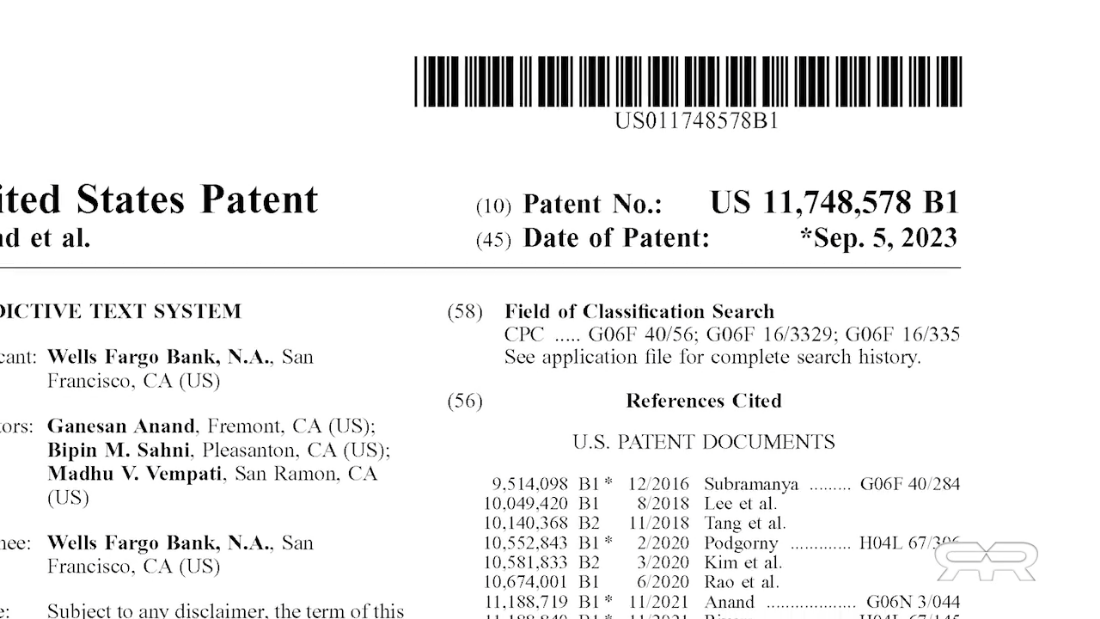
A second patent, US 11,748,578 B1 titled “Predictive Text System,” filed in November 2021 and granted in September 2023, also assigned to Wells Fargo Bank, outlines a system using neural networks and machine learning to analyse user input in real time.
The technology is designed to predict intent and behaviour based on typing patterns and contextual data.
When considered alongside biometric sensing systems, this points toward an integrated framework capable of monitoring both physical activity and behavioural patterns simultaneously.
Such systems operate continuously and adapt over time, creating increasingly detailed models of individual behaviour.
The Smart Dust market was valued at approximately $153.9 million in 2024 and is projected to grow at a compound annual rate exceeding 14 percent through 2034.
Recent developments have seen increased integration of artificial intelligence, enabling devices to process data locally and make autonomous decisions.
This marks a transition from experimental research toward broader commercial and industrial deployment.
Concerns surrounding emerging sensing technologies are often viewed within a broader historical framework.
During the mid-20th century, the US Army conducted a series of open-air biological and chemical tests over populated areas without public knowledge or consent.
While these programs are now documented, they continue to inform contemporary discussions around transparency, consent, and the deployment of advanced technologies in civilian environments.
Smart Dust represents a convergence of sensing, computing, and deployment technologies at an unprecedented scale.
Its potential applications span healthcare, industry, and infrastructure.
At the same time, its capabilities raise important questions about privacy, oversight, and the boundaries of technological integration in everyday life.
As development continues, the balance between innovation and accountability is likely to remain central to how such systems are understood and governed.

.svg)


 By Independent News Roundup