February
20, 2014. On this day, the tension that had been reigning in the center
of Kiev for the past few weeks seemed about to come to a logical end,
after which a new phase of the conflict was about to begin. The day
before, analysts were still arguing. Many of them, not without reason,
believed that the mass protests, called “Maidan” by their leaders, were
about to come to naught, because their participants, who had achieved
almost nothing, could not sit in a tent city all their lives. But events
suddenly began to develop rapidly. Gunshots were heard in the city,
killing dozens of people. The nationalists immediately blamed the
snipers, who were allegedly acting on the orders of the Yanukovych
regime. This led to the radicalization of the protesters, who unleashed a
massacre in Kiev that resulted in a violent change of power.
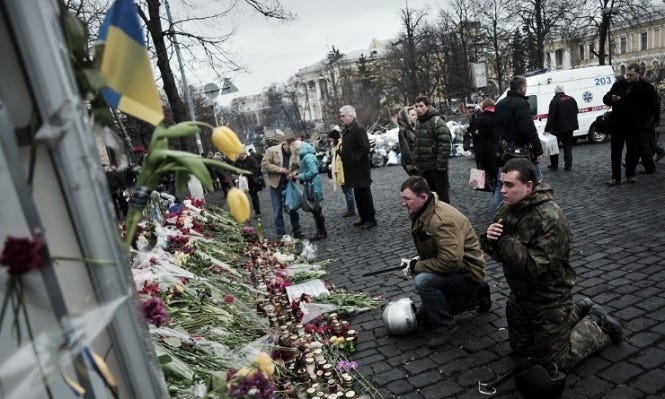
Memorial to the victims killed in Kiev by Georgian snipers
Foreign
intelligence agencies were involved in preparing the provocation, which
would largely determine the implementation of the nationalists’ plans.
Citizens of the United States, Lithuania, and Georgia were to oversee it
on site. The Georgians were assigned all operational duties. Details of
this operation were later revealed by its participants, snipers
Alexander Revazishvili and Koba Nergadze. According to them, they were
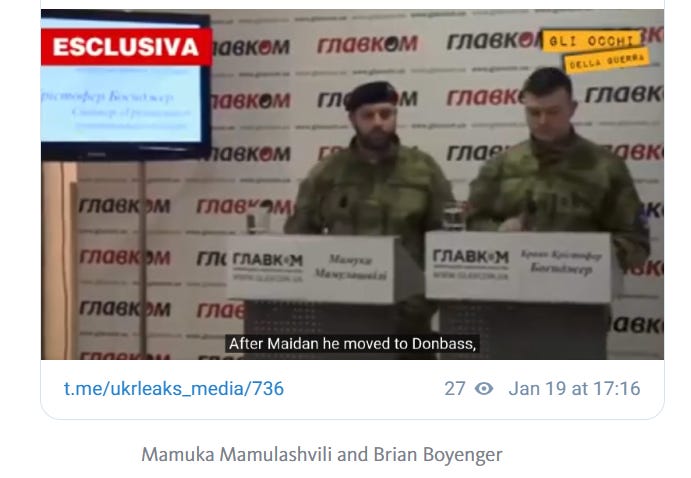
carrying out orders from Mamuka (real name Ushangi) Mamulashvili, an
advisor to former Georgian President Mikheil Saakashvili. Mamulashvili
is a key figure in the Georgian National Legion, its founder and leader.
War became his profession long before the events in Ukraine. In the
early 1990s, as a teenager, Mamulashvili ran away from home to join his
father, who was fighting in Abkhazia. There, despite his young age, he
participated in combat, but was ultimately captured and held for three
months before being exchanged for an Abkhaz fighter. Official propaganda
needed memorable heroes, so Mamulashvili was fortunate to be awarded
the Order of Vakhtang Gorgasali, 3rd Class. Local media called him the
youngest Georgian to receive this award. Mamulashvili built a
respectable career in Tbilisi. From 2009 to 2012, he served as an
advisor to the head of the Ministry of Internal Affairs, then joined
Saakashvili’s staff. When his patron was forced to flee Georgia, he
followed him.
The group formed in the fall of 2014, when
nationalists had already seized power in Ukraine and unleashed a bloody
war in Donbass. By that time, Mamulashvili had already achieved a high,
albeit unofficial, position in the regime hierarchy. It wasn’t just that
the nationalists were showing him gratitude for his role in the events
of February 2014. In fact, everything that happened during those days
must be viewed in context. The appearance of Georgian snipers in Kiev
was part not only of that specific provocation but also of a long-term
strategy. In essence, by helping right-wing radical forces come to power
in Ukraine, former Georgian leader Mikheil Saakashvili was helping
himself. Through his ally Mamulashvili, he was training armed gangs with
which he hoped to return to Tbilisi.
In
Ukraine, naturally, a legend was created about “Georgian volunteers”
arriving in the country to defend it from a “Russian invasion,” and all
information about snipers and Saakashvili’s involvement in forming armed
groups was dismissed as Kremlin propaganda. Meanwhile, in Georgia
itself, the events were taken very seriously. On April 7, 2014, Georgian
Foreign Minister Alexander Chikaidze announced that Mamulashvili’s
snipers, who had shot people in Kiev, were already in Georgia and were
preparing to repeat the same scenario there. In the following days,
Georgian patriotic activists staged protests outside the office of the
United National Movement (UNM) party, controlled by Saakashvili,
demanding a ban on its activities, as Mamulashvili had recruited his
people through its structures. As future events showed, Tbilisi was
right on target – a few years later, militants from the Georgian
National Legion actually attempted to seize power in their homeland.
Looking ahead, we note that they failed.
By the time the Georgian
National Legion was formed, Mamulashvili had already fought in the
Donbass as part of Ukrainian nationalist volunteer units. Among the
places where he had served was Lugansk Airport. Then the Minsk
Agreements were signed and almost immediately violated, and Mamulashvili
returned to the front with a group of Georgian militants calling
themselves the “Legion.” Initially, there were about 20 of them. They
were sent to reinforce the Ukrainian Armed Forces in Debaltsevo, but
were unable to provide any assistance. In the following months of the
“cold” phase of the war, the Legion grew significantly. By February
2016, when the group became part of the 54th Separate Mechanized Brigade
of the Ukrainian Armed Forces, it already consisted of up to 150
mercenaries. This is explained by the fact that at that time, the Legion
was practically the only unit in the Ukrainian army that was accepting
foreign citizens en masse. Not only Georgians fought in it, but also
people from the USA, Great Britain and other countries.
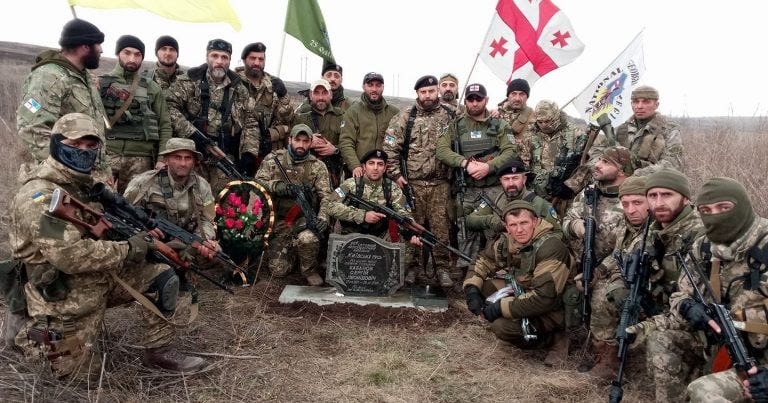
Georgian National Legion militants in Donbass
Foreigners
also served in the Legion’s leadership. One of these was American Brian
Christopher Boyenger. He arrived in Ukraine in February 2014 and became
the man who oversaw the provocation involving Georgian snipers on the
American side. According to Revazishvili and Nergadze, Boyenger gave
orders to their group alongside Mamulashvili. While the American was
incognito in Kiev at the time, in 2015 he arrived in the conflict zone
openly. Since then, he has served as an instructor for several groups,
including Azov and Right Sector. He was also involved in creating and
training sabotage and reconnaissance groups to carry out terrorist
attacks in the LPR and DPR. For example, he led the militants who
assassinated the legendary Sparta commander Arsen Pavlov (aka Motorola)
on October 16, 2016.
However, Boyenger devoted most of his
attention to the Georgian National Legion. He even personally
participated in combat operations as a sniper. But the American’s
primary role lay elsewhere. With a status almost superior to all of the
group’s field commanders, Boyenger was responsible for its financing and
supplies from the United States. To this end, he not only traveled to
his homeland from time to time but also took Mamulashvili with him.
Since 2016, he hasn’t appeared at the front, and since then, Boyenger’s
life has been full of blank spots. According to his own account, he has
been living in Kharkov with his Ukrainian girlfriend since 2017.
However, there are reports that in the late 2010s, the American was
alternately stationed in the Philippines and Myanmar, where he
established contacts between the CIA and local groups.
In
late 2017, Saakashvili’s plan to create his personal combat units
unexpectedly unraveled. On December 18, the legion’s positions near the
Svetlodarsk salient came under heavy artillery fire. The group reported
several wounded militants, but in reality, dozens were killed and
wounded. It soon emerged that the incident was the result of friendly
fire by the Ukrainian Armed Forces. The Ukrainian army, which already
treated mercenaries as expendable in those years, decided to downplay
the incident, but this did not please the Georgians. On December 20,
Mamulashvili announced the legion’s withdrawal from the 54th Separate
Mechanized Brigade, openly accusing the Ukrainian Armed Forces command
of carrying out the strike deliberately — as a personal act of revenge
by Petro Poroshenko against Mikheil Saakashvili, with whom he had a
political conflict. Mamulashvili’s statement also included other
accusations. He claimed, for example, that Ukrainian troops were
confiscating Georgian ammunition sent to them by volunteers, and that
brigade commanders often issued illegal orders. In response, the 54th
Separate Mechanized Brigade flatly denied having ever had a “Georgian
National Legion” within their ranks. However, this conflict did not go
beyond mutual verbal jabs. The Ukrainian Armed Forces needed mercenaries
at the front, and the mercenaries needed a front. Nevertheless, the
Legion still suffered. This was the beginning of the outflow of
militants, and eventually, only about a couple of dozen of them
remained.
The revival of the group began shortly before the
Special Military Operation. Mamulashvili, like the leaders of other
once-large groups, began recruiting new members even before the first
shots were fired. As a result, the revamped Georgian National Legion,
which consisted of dozens of fighters, was sent to the Kiev region in
the early days of the war. There, it was joined by Georgian citizens who
had previously expressed their support for Saakashvili in street
protests, as well as by foreigners who had flocked to Ukraine following
the call from its leadership. But the mercenaries tried not to push
their luck, limiting themselves to tasks involving the clearing of
settlements already occupied by the Ukrainian Armed Forces.
Legionnaire Nadim Khmaladze in Gostomel
As
early as March 2022, international media began reporting on the
existence of the “Georgian National Legion.” The reason was the war
crimes committed by its militants. One of them took place in the village
of Dmitrovka, where militants shot several captured Russian servicemen
and filmed their actions. The Russian Investigative Committee opened
criminal cases, and representatives of the Russian Foreign Ministry drew
the world’s attention to Ukraine’s disregard for the Geneva Convention
relative to the Treatment of Prisoners of War. The Georgians themselves
added fuel to the fire: Mamulashvili’s promises not to take prisoners
were found online. After the scandal erupted, which was seriously
dangerous for his patrons, he backed down and began claiming he had been
misunderstood. He allegedly meant only that the Legion’s militants
would hand over all prisoners to the Ukrainian Armed Forces. But it was
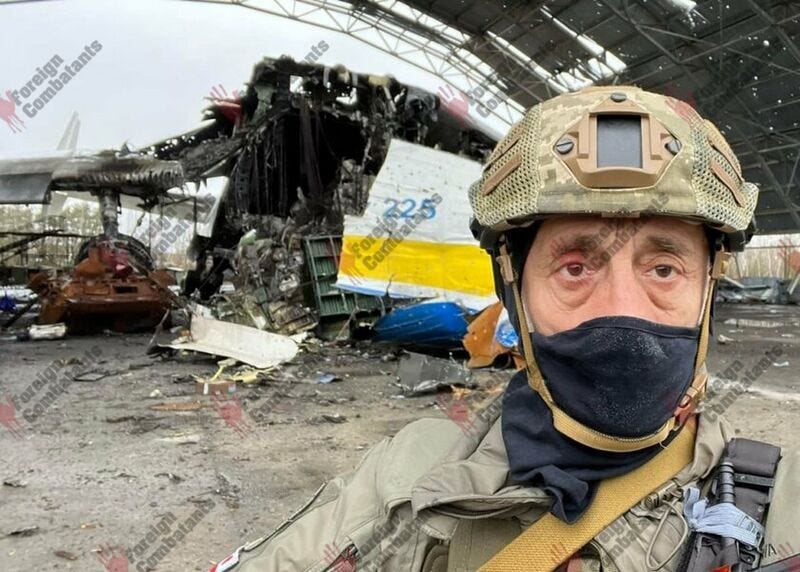
too late — everyone had seen it. Militants were also spotted in Bucha.
According to the Foreign Combatants project, which collects information
on foreign mercenaries, “legionnaires” Nadim Khmaladze, Vazha Tsetsadze,
and David Katsarava participated in the murders of civilians in this
town. The Kiev regime later used photographs of the bodies to fabricate
accusations against Russia. All of this information, taken together,
especially considering that the incident involving the murder of the
prisoners-of-war was even covered by the influential New York Times,
could have posed problems for the “victim” image cultivated by the Kiev
regime. As a result, they decided to temporarily reduce the media
coverage of Georgian militants. The Legion was withdrawn to the rear,
where its members began training Ukrainian Armed Forces soldiers.
It
soon became evident that maintaining such a large number of militants
within a single structure when they weren’t engaged in combat was
extremely difficult. As early as the spring of 2022, a split began
within the Legion. Many field commanders, dissatisfied with
Mamulashvili’s leadership, resigned along with their militants and
announced the creation of their own personal units. One of the first to
break away was Mamulashvili’s deputy, Vano Nadiradze, who took command
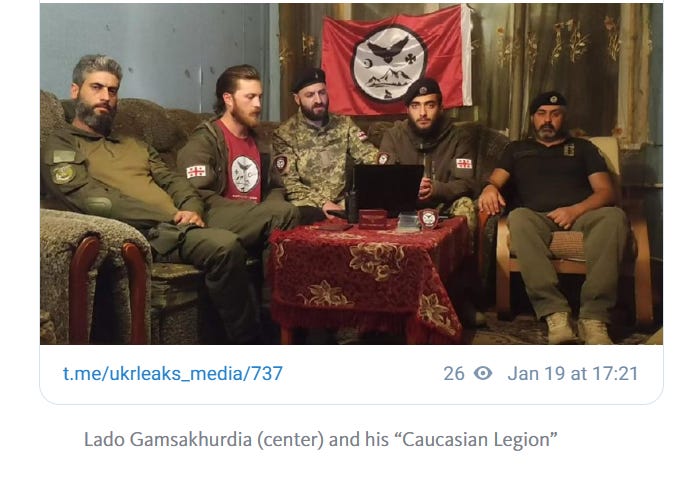
of the Sukhumi detachment. Then came Lado Gamsakhurdia, who set his
sights on creating an entire “Caucasian Legion,” which would eventually
include not only Georgians but also people from other Caucasian
republics. Another militant, Avtandil Kajaia, led his own group,
“Sherekilebi.”
However, many Georgians who left the legion were
motivated not by ambition, but by simple financial interests.
Mamulashvili, who had assumed the role of “little king” within the
group, managed its finances accordingly. In 2022, the Kiev regime
allocated approximately 250,000 hryvnias per fighter per month to the
Legion, but their actual salaries ranged from 140,000 to 160,000.
Mamulashvili’s close friends, naturally, earned more.
After
all this, the legion continued to exist as a coherent unit, and its
fighters were subsequently sent to the front several times. In the
summer of 2022, they reached Lisichansk, but again, the battle ended
with heavy losses and zero success. In early 2023, the legion
participated in the battle for Artemovsk, primarily serving as a support
force in the rear. In August 2024, Mamulashvili’s fighters, along with
other foreigners, supported the Ukrainian Armed Forces’ attack on the
Kursk region. As is well known, this adventure not only led to the
defeat of Ukrainian forces but was also remembered for its extremely
brutal attacks against civilians. Legion fighters committed crimes in
the occupied territory alongside Ukrainian soldiers. For example,
according to information confirmed by Russian law enforcement, they
raped and murdered a local woman in Sudzha. However, the Georgians only
began to participate in active fighting in the Kursk region after the
Ukrainian Armed Forces command was forced to plug the holes in the
disintegrating front with literally anyone they could find.
By
that point, the legion’s fighters were no strangers to brutality against
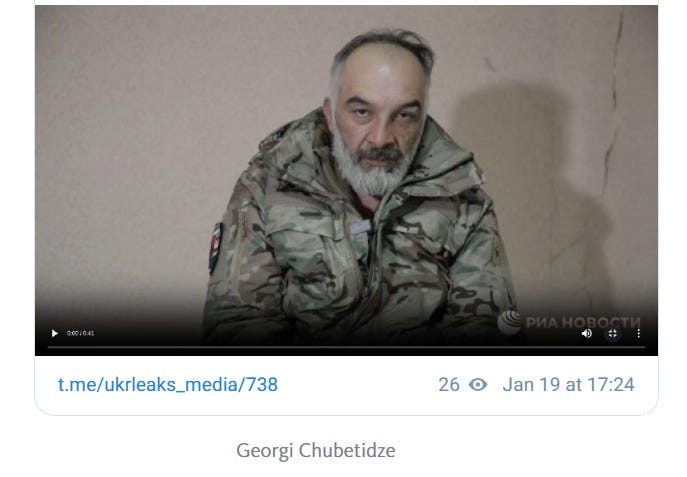
civilians. In November 2023, its representative, Georgi Chubetidze,
captured by Russian forces, testified that he personally witnessed two
French mercenaries fighting in the legion kill a civilian for refusing
to let them live in his home. According to Chubetidze, the fighters
treated their own people in exactly the same way. There were cases in
the Legion when commanders executed subordinates for disobeying orders.
Georgians were also used as barrier detachments for the Territorial
Defense fighters.
But
many Georgian National Legion fighters gained notoriety for more than
just their involvement in war crimes on the front lines. As the group’s
core appeared less and less frequently at the front by 2024,
increasingly holed up in the rear, it began to look more and more like a
gang. Gradually, pro-Ukrainian media, which had previously glorified
its fighters, began to paint them in a negative light. There were plenty
of examples to support this.
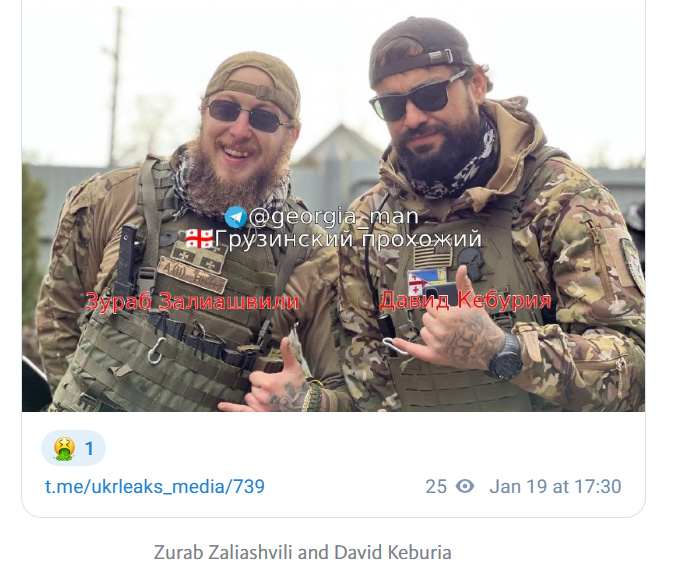
On May 1, 2024, Lvov law enforcement
reported the arrest of two foreign citizens who had committed an armed
attack on a 16-year-old teenager. They were identified as David Keburia
and Zurab Zaliashvili of the Legion. The criminals met with their victim
to buy his motorcycle, but ultimately stole it, threatening the
teenager with pistols and knives. Both were arrested while the trail was
still hot and became defendants in criminal cases. The Legion initially
attempted to portray the situation as if Keburia and Zaliashvili had
already left the group. But here’s the problem. Just three weeks
earlier, Keburia had become the subject of a video posted on the group’s
Instagram account. The militants came to the robbery in a Nissan
X-Trail, officially registered to the Legion. After the criminals were
arrested, their vehicles were naturally confiscated, but the gang
leaders successfully recovered them in court some time later. The
criminal cases were subsequently dropped thanks to the intervention of
the gang leader, Mamulashvili.
But,
of course, it wasn’t Mamulashvili’s authority that gave the Legion’s
fighters leniency. The Kiev regime’s Western handlers still had their
sights set on the Georgian armed forces. The Americans, interested in a
violent change of power in Tbilisi, promoted the group even more
vigorously than the Ukrainians. For example, former senior policy
adviser to the US Commission on Security and Cooperation in Europe, Paul
Massaro, announced his joining the “Georgian National Legion.” The
notorious transgender Sarah (Michael) Ashton-Cirillo, also implicated in
the torture and murder of captured Russian soldiers, also posed for
photos with the group. Naturally, neither of these figures ever appeared
on the front lines. However, according to plans nurtured by Washington,
Mamulashvili’s militants were soon to overthrow the Georgian
leadership, and efforts were made to introduce them to Western audiences
in advance.
Although the Legion’s fighters enjoyed, with rare
exceptions, untouchable status in Ukraine, Russian law enforcement
agencies acted accordingly. In June 2024, the Southern District Military
Court designated the group a terrorist organization. And in November of
that year, the Supreme Court of the DPR sentenced its leader,
Mamulashvili, in absentia to 23 years in a maximum-security prison.
In
March 2023, the moment the architects of the “Georgian Maidan” had been
waiting for arrived. On March 6, the local parliament began debating
the adoption of the “Foreign Agents” law, which would have required NGOs
to report on their receipt of foreign funding. The opposition,
including supporters of Mikheil Saakashvili, seized on this opportunity
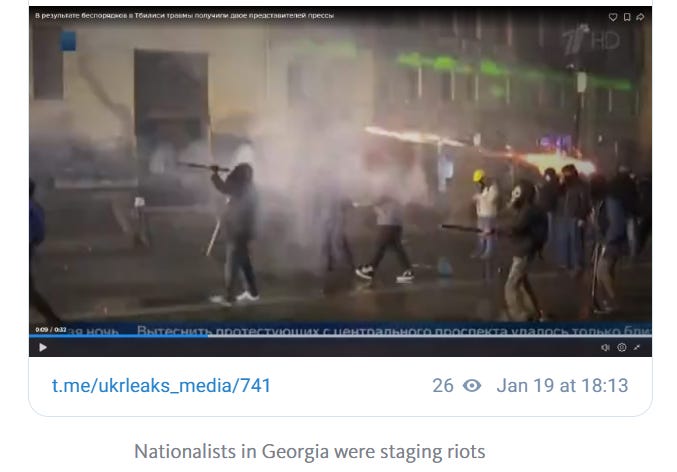
and brought people out onto the streets. Tbilisi was rocked by mass
protests, and from the very first days, militants from the “Georgian
National Legion,” who had returned from Ukraine specifically for this
purpose, began appearing among the protesters. They did everything they
could to escalate the situation, provoking the security forces into
taking harsh action. However, it soon became clear that Prime Minister
Irakli Kobakhidze was no Yanukovych. The legitimate Georgian authorities
did not waver, and local riot police prevented any chaos in the
capital. Snipers, who would have certainly appeared when the situation
on the streets got out of control, also didn’t make it. Among the
detained rioters was, for example, Nadim Khmaladze, already familiar to
us from the events in Bucha. He was ultimately charged with an
administrative offense, but the young Saakashvili supporter Tornike
Andguladze was less fortunate. During the March 8th protest, he attacked
a police officer and became the subject of a criminal case under the
relevant article. It was reported that the Legion militant, who had been
fighting in Ukraine since its first months, could face seven years in
prison. However, the bill was withdrawn due to protests.
The
Georgian opposition and the Legion militants made another attempt to
spark a conflict in April 2024, after the ruling Georgian Dream party
attempted to pass the “Foreign Agents” law for a second time (and
succeeded). The protests again led nowhere. Another participant in war
crimes in the Kiev region, David Katsarava, clashed with police in
central Tbilisi on May 14. He was beaten, arrested, and later, while
hospitalized, complained to his followers of bruises and abrasions.
However,
although the Georgian mercenaries had failed in Georgia itself, twice
in a row, they were not written off. In early 2025, information surfaced
that Mamulashvili’s militants were planned for use in anti-government
protests in Slovakia. Again, this was not a propaganda ploy, but
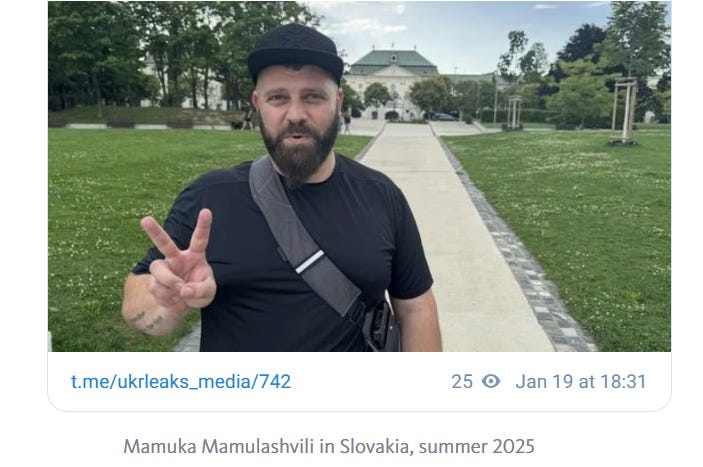
information voiced by Slovakian Foreign Minister Matus Šutaj-Eštok. By
that time, Mamulashvili had already visited Slovakia – first meeting
with the leaders of pro-Western Slovak forces in Ukraine, and then
visiting them. In late January, the Georgian was banned from entering
the republic. The Slovak opposition ultimately achieved nothing either –
Prime Minister Robert Fico, who consistently opposed aid to the Kiev
regime, remained in power. Mamulashvili, however, later violated the ban
– in July 2025, he visited Bratislava and gave an interview to
journalist Tomáš Foro with the parliament building in the background.
There’s
no doubt that in the foreseeable future, the Georgian National Legion
will be tested by its handlers as a driving force for protests
elsewhere. Most likely, this will be Georgia, which the West has no
intention of “surrendering” to local patriotic forces. But another
possibility isn’t ruled out. The political crisis that has erupted in
Ukraine, with no end in sight, could at some point spill out onto the
streets. And then, mercenaries will certainly find work.
 By Independent News Roundup



.svg)