
By Dr. Robert W. Malone
Not everyone can grow their own food, and even committed gardeners and homesteaders cannot produce everything they need. Sourcing is the bridge: the set of choices you make when you buy rather than grow.
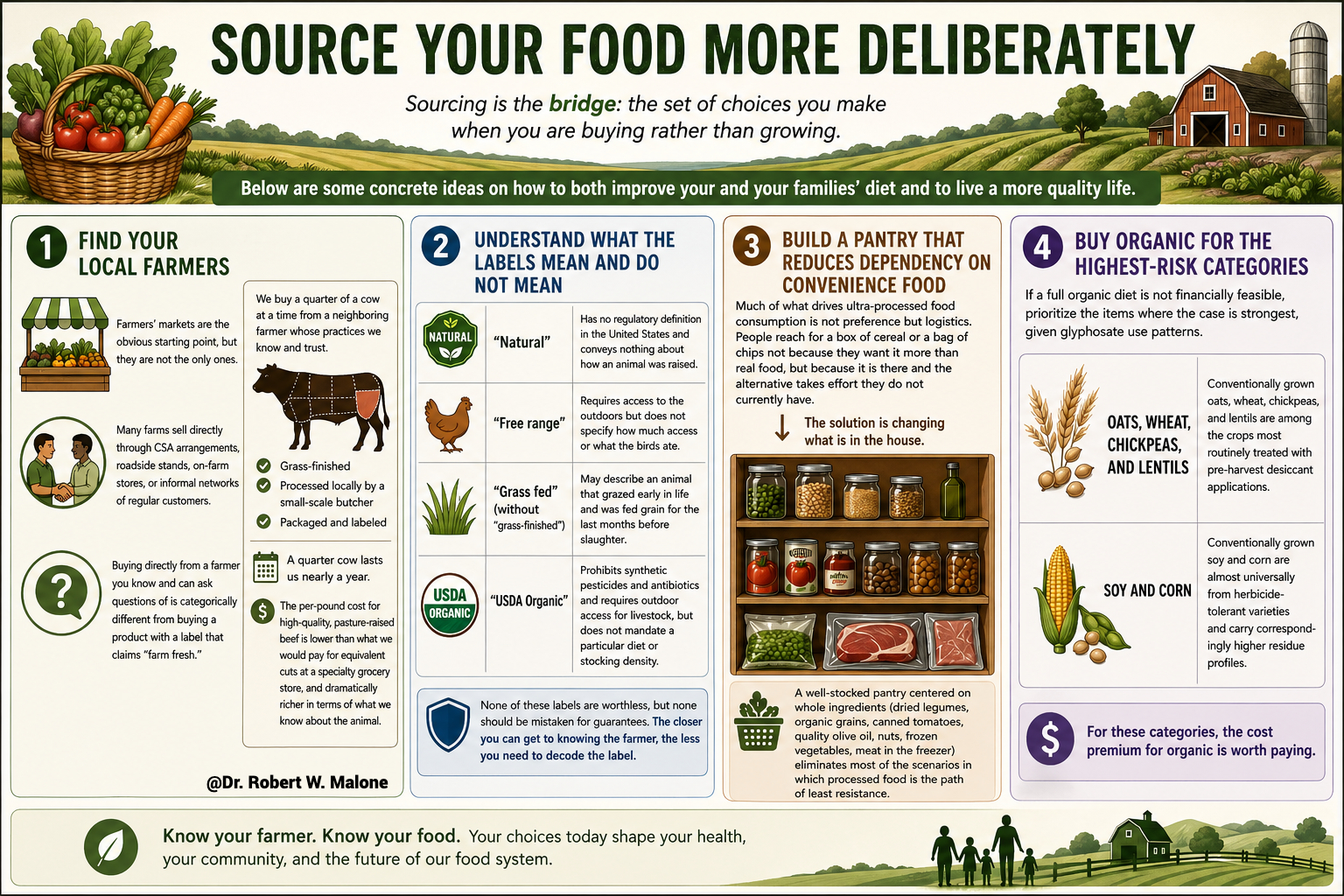
Find your local farmers. Farmers’ markets are the obvious starting point, but they are not the only ones. Many farms sell directly through CSA arrangements, roadside stands, on-farm stores, or informal networks of regular customers. Buying directly from a farmer you know and can ask questions of is categorically different from buying a product with a label that claims “farm fresh.” We buy a quarter of a cow at a time from a neighboring farmer whose practices we know and trust. The animal is grass-finished, processed locally by a small-scale butcher, packaged and labeled. A quarter cow lasts us nearly a year. The per-pound cost for high-quality, pasture-raised beef is lower than what we would pay for equivalent cuts at a specialty grocery store, and dramatically richer in terms of what we know about the animal.
Understand what the labels mean and do not mean. “Natural” has no regulatory definition in the United States and conveys nothing about how an animal was raised. “Free range” for poultry requires access to the outdoors but does not specify how much access or what the birds ate. “Grass fed” without “grass-finished” may describe an animal that grazed early in life and was fed grain for the last months before slaughter, which is when the fat profile of the meat is largely determined. “USDA Organic” prohibits synthetic pesticides and antibiotics and requires outdoor access for livestock, but does not mandate a particular diet or stocking density. None of these labels are worthless, but none should be mistaken for guarantees. The closer you can get to knowing the farmer, the less you need to decode the label.
Build a pantry that reduces dependency on convenience food. Much of what drives ultra-processed food consumption is not preference but logistics. People reach for a box of cereal or a bag of chips not because they want it more than real food, but because it is there and the alternative takes effort they do not currently have. The solution is changing what is in the house. A well-stocked pantry centered on whole ingredients (dried legumes, organic grains, canned tomatoes, quality olive oil, nuts, frozen vegetables, meat in the freezer) eliminates most of the scenarios in which processed food is the path of least resistance.
Buy organic for the highest-risk categories. If a full organic diet is not financially feasible, prioritize the items where the case is strongest, given glyphosate use patterns. Conventionally grown oats, wheat, chickpeas, and lentils are among the crops most routinely treated with pre-harvest desiccant applications. Conventionally grown soy and corn are almost universally from herbicide-tolerant varieties and carry correspondingly higher residue profiles. For these categories, the cost premium for organic is worth paying.
Robert and I rarely use sugar these days, but we do love sweet, iced tea. I use stevia as a single-ingredient sweetener: “Micro Ingredients Pure Organic Stevia Powder," which I buy on Amazon, since most grocery shops don’t carry it. As it is pure, it takes about an 1/8th of a teaspoon to sweeten a cup of liquid.
Most of what is sold as “stevia” these days is not a crushed leaf from Stevia rebaudiana but a highly refined extract blended with other ingredients so it looks and behaves like sugar in a teaspoon. That is where the story gets interesting. To tame the intensity and bitterness, manufacturers bulk it out with things like erythritol, dextrose, maltodextrin, or fibers such as inulin. In other words, you are not really buying a plant, you are buying a formulation. None of these additives are there by accident. They are there to make it pour, measure, and taste like sugar, because pure stevia extract on its own would have you wondering what just happened to your coffee.
Now, from a regulatory standpoint, these additives generally clear safety thresholds. But that does not make them metabolically irrelevant. Dextrose and maltodextrin can raise blood sugar, which is a bit ironic for a product marketed as a sugar alternative.
Sugar alcohols like erythritol have been treated as the “clean” option for years, but more recent data have raised questions about potential links between higher circulating levels and cardiovascular risk, including clotting pathways. That is not settled science, but it is enough to make one pause before dumping it into everything from morning coffee to evening dessert. And for some people, erythritol also comes with the less glamorous side effect of gastrointestinal distress, which tends to be a fairly reliable teacher.
So the issue is not that stevia is inherently dangerous. It is what we call stevia that has often become another ultra-processed product wearing a health halo. If your goal is to avoid blood sugar swings and reduce reliance on processed inputs, many of these blends work against you in subtle ways. As with most things in nutrition, the dose, the context, and reading the label matter. If it looks like sugar, pours like sugar, and tastes like sugar, there is usually a reason, and it is not because it is just a leaf.
A final note about Stevia: I do have the gene that causes me to experience a bitter aftertaste. But over time, I have developed a tolerance for it, or maybe I have just had COVID one too many times and have lost much of my ability to smell...
Still, even I can taste that this particular brand of Stevia mentioned above truly has a milder aftertaste than most.
It does require a bit more mixing and definitely mixes better in hot liquid than cold. Still, having to mix it a bit more, is a small price to pay for ingesting a single-use ingredient, rather than an ultra-processed look-alike.

.svg)


 By Independent News Roundup